The molecule.
The conversion.
The distinction.
GUT CONVERSION · SIMPLIFIEDDaidzein → Gut bacterial conversion → S-equol
Some people’s gut bacteria can form S-equol from daidzein. S-equol is a different molecule from this precursor.
DIRECT SUPPLEMENTATIONAlready-formed S-equol → Supplied directly
Obtaining the supplemented S-equol does not require first converting daidzein into S-equol in the gut. This does not mean that absorption, metabolism or individual responses are identical.
About S-EQUOL PLUS
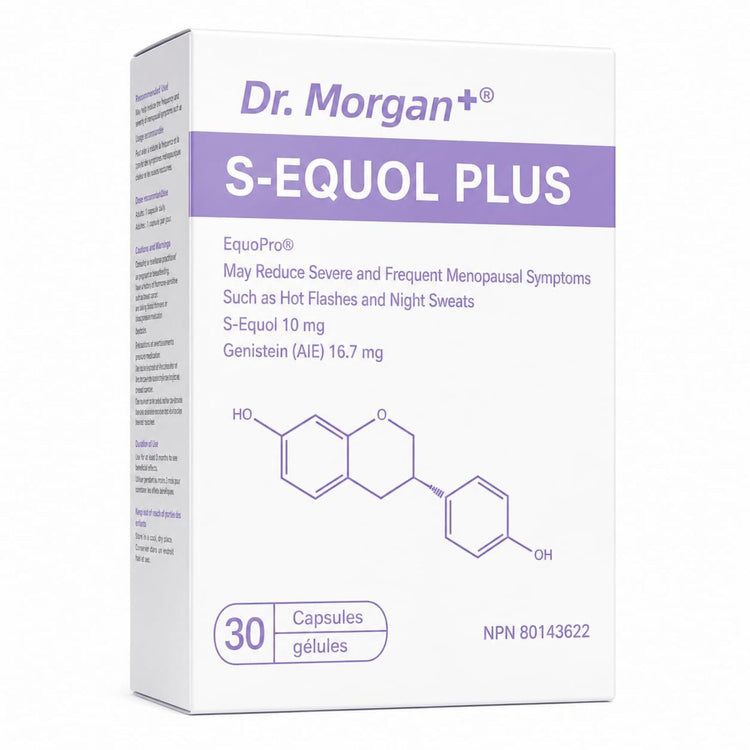
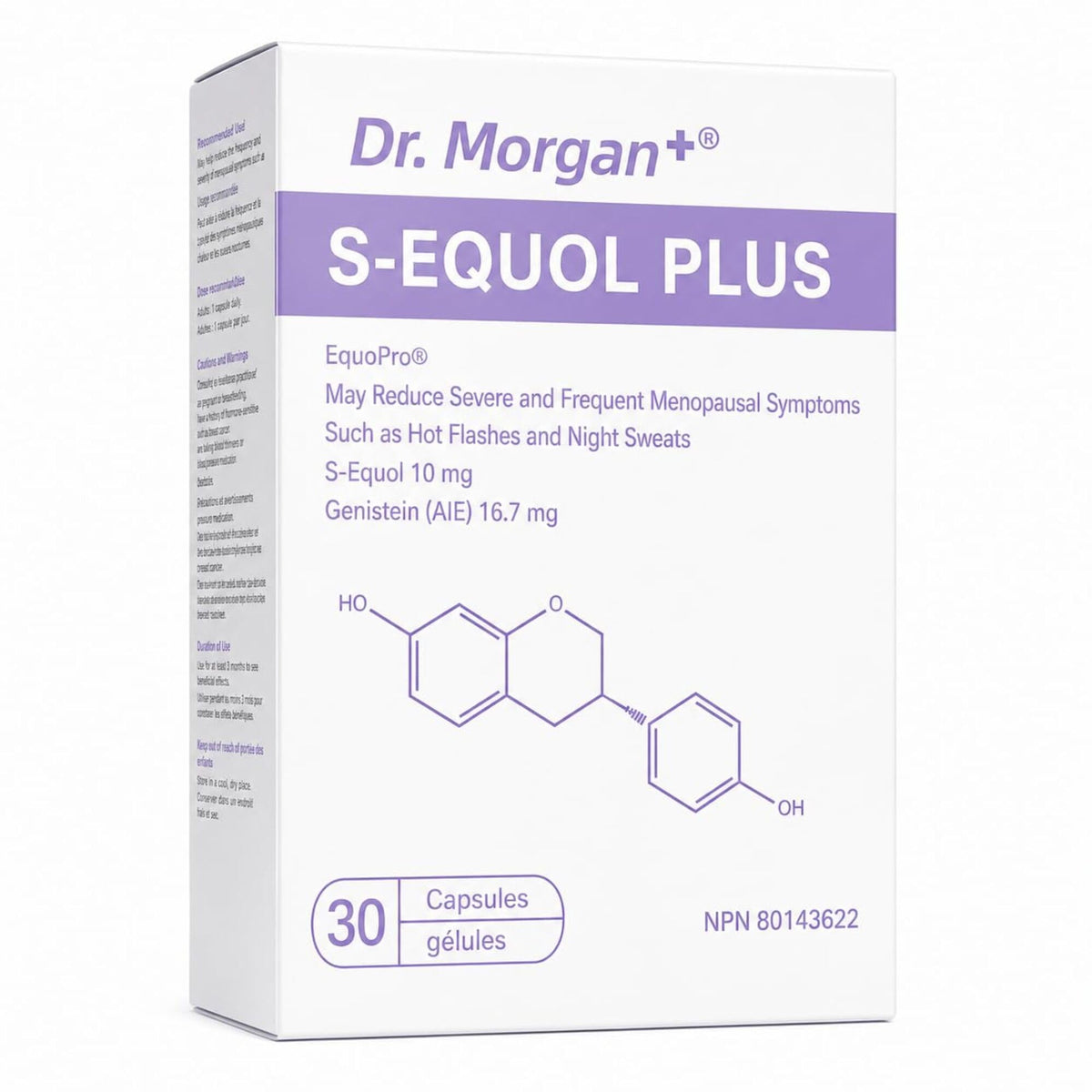
S-EQUOL PLUS contains synthetic S-equol and Genistein. The Genistein is sourced from Glycine max (soybean) seed.
Sources & contextSetchell et al., 2005 · Original mechanism / pharmacokinetic study ↗Ingredient-level evidence; not a clinical trial of DR.MORGAN S-EQUOL PLUS. The pharmacokinetic component involved three healthy adults.
Setchell & Clerici, 2010 · Formation review ↗Product licence: Health Canada, NPN 80143622. The animation is a simplified molecular illustration, not a real-time biological recording or an efficacy comparison.
Animation sources & scope
1. Bacterial conversion
The pathway is simplified from enzyme work in Lactococcus strain 20-92. The published model includes an R/S dihydrodaidzein racemase step. The animation groups that step into DHD, shows S-DHD and the (3S,4R)-THD branch, and omits cofactors, hydrogens and alternative reactions. It does not claim that every bacterium uses this exact sequence.
Shimada et al. (2012). Identification of a novel dihydrodaidzein racemase essential for biosynthesis of equol from daidzein in Lactococcus sp. strain 20-92. Applied and Environmental Microbiology 78:4902–4907.
DOI: 10.1128/AEM.00410-12
2. Individual variation
Human observational research found relevant bacterial groups in producers and non-producers. Detecting bacteria alone does not establish that the complete conversion occurs. The illustration does not show prevalence or predict treatment response.
Iino et al. (2019). Daidzein intake is associated with equol producing status through an increase in the intestinal bacteria responsible for equol production. Nutrients 11:433.
DOI: 10.3390/nu11020433
3. Ingredient identity
Setchell and colleagues identified S-equol as the enantiomer produced by human intestinal bacteria. This supports molecule identity, not a claim of finished-product efficacy.
Setchell et al. (2005). S-equol, a potent ligand for estrogen receptor beta, is the exclusive enantiomeric form of the soy isoflavone metabolite produced by human intestinal bacterial flora. American Journal of Clinical Nutrition 81:1072–1079.
DOI: 10.1093/ajcn/81.5.1072
How the illustration was made
Original ball-and-stick models use verified connectivity. Navy represents carbon; lavender represents oxygen; hydrogen atoms are omitted. Conformers are computational illustrations, not measured molecular motion. Bond changes are schematic transitions, not an atom-balanced reaction simulation. Cells, molecules and time are not to scale.
Daidzein · PubChem 5281708
S-equol · PubChem 91469
These studies were not conducted on the finished DR.MORGAN S-EQUOL PLUS product. No licensed product claims are changed.


 PRODUCT INFORMATION


